
What you’ll find inside
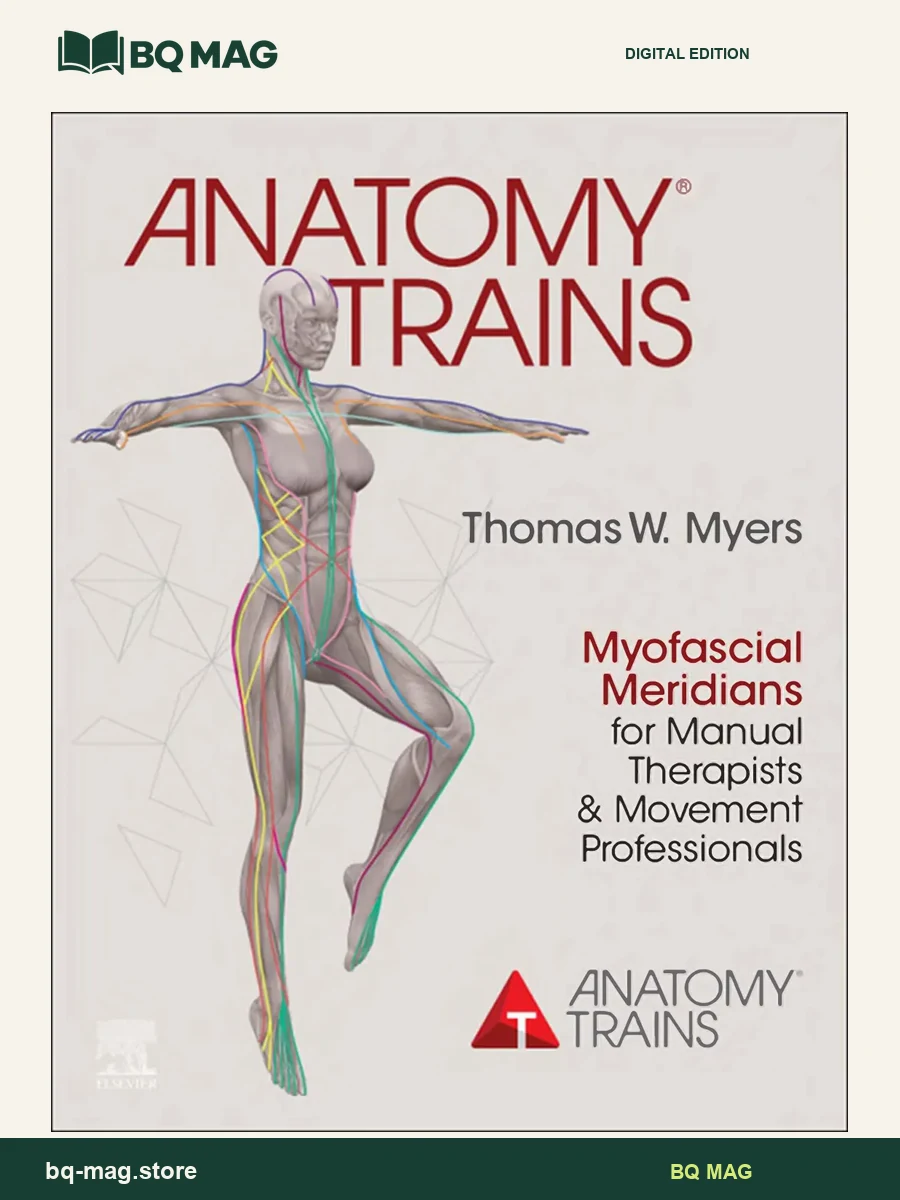
Anatomy Trains: Myofascial Meridians for Manual Therapists and Movement Professionals, Fourth Edition, by Thomas W. Myers, presents a regional map of connective tissue relationships across the body. It introduces the author’s myofascial-meridian model and considers how linked structures may inform movement observation, posture analysis, and hands-on practice. The fourth edition adds material on movement, fascia, and quadruped anatomy alongside its established line-by-line organization.
What does Anatomy Trains explain?
The text begins with the framework for reading the “lines” and then explores the Superficial Back Line, Superficial Front Line, Lateral Line, Spiral Line, Arm Lines, Functional Lines, and Deep Front Line. Each route offers a way to study how muscles and connective tissues relate across regions rather than viewing each muscle in isolation. The book also includes a structural-analysis chapter and appendices that place the Anatomy Trains concept alongside structural integration and other approaches to body mapping.
How does the fourth edition connect fascia with movement?
Later chapters examine Anatomy Trains in movement and discuss gait-related myofascial force transmission. The edition includes a substantial fascial reader, material on quadrupeds, and contributions from James Earls, Karin Gurtner, and veterinary contributors. This lets readers move between an anatomical map, observation of movement, and examples of how the author’s model has been applied in manual and movement settings.
Who is this myofascial anatomy book for?
The title is aimed at manual therapists and movement professionals who want a structured reference for fascia, posture, and linked muscular patterns. Its vocabulary and conceptual diagrams may also suit students of massage therapy, physical therapy, structural integration, yoga, and movement education. It describes a model used for analysis; it does not replace an individual clinical assessment, professional training, or evidence-based care.
Check the fourth edition and PDF format
Elsevier lists the fourth edition at 378 pages, with approximately 578 illustrations. This listing is for a PDF ebook; digital page counts can differ from the printed edition. Select Preview ebook to inspect four sample images and confirm the edition before choosing the book.
Browse more fitness and rehabilitation ebooks or return to the ebook catalog.


ELIZABETH ANN RACEHORSE –
Excellent service, exactly as described.
Alisha Evans –
Beautifully done! Love the cadaver pictures. I do medical massage, so it is nice to be able to really see the direction of muscle fibers and fascia, not just imagining from an illustration. There are several great illustrations in this ebook as well. Ebook is well organized and a fairly easy read given the content. Well written. I really love this ebook. I keep it close at hand, because it is also a great reference guide. Would definitely buy again.
Deb –
clear, easy read, educational
seda –
Not only the content but also the print quality of the ebook is amazing.
Julie I Sedell –
I am so glad I purchased this; it’s got really excellent information in it about how to think about the different sheaths of fascia and how they layer within the body. I have really poured over it and, as a massage therapist, found very applicable techniques or new combinations of techniques to use to alleviate tension and pain. The most enlightening parts for me were; 1. that the rectus femoris is at the same level as the rectus abdominus. So if you stretch them together (moving in the same direction either up or down (cephelad or caudad); or in opposition to each other (usually after moving them in sync ) ) that great things happen for my clients. And 2. The deep neck muscles along the transverse processes of the cervical vertebrae are at the same level of the psoas muscles. So for people with deep, core tension, working these (while they are face down) and adding manipulation of the serratus anterior muscle has been super helpful for my clients who were not really making progress past a certain point. Everyone is happy and my business is booming. I highly recommend this ebook!
SubparFiddle –
This ebook is a gift to humanity, an honest way out of the darkness of the current age.
Aggie –
This is my favourite ebook! As a professional, I’m always looking to develop my skills and knowledge, and this ebook is incredibly insightful. It provided a deep understanding of myofascial meridians, which has greatly influenced how I approach massage, movement, and fascia work in my practice. The illustrations, explanations, and practical applications make it a must-have for therapists, trainers, and anyone serious about understanding the body’s connective tissue system. It truly inspired me to study fascia more thoroughly and apply these concepts professionally.
Michele –
I’ve only just started this ebook, but the bucket itself is highly regarded! It was the basis for one of my Pilates trainings. It’s known as a go to for all movement professionals. However, in the latest edition, they incorporated videos with the ebook, where at certain points you’re referred to look at a video. First of all, it was very hard to get access to the video, and a major pain in the butt. Secondly, I buy the ebook as I wanted to read, not watch videos. Thirdly, while he seems like a lovely guy, I find his speaking style odd, and very distracting, to the point where it’s kind of hard to make it through these videos. Next time just make a bigger ebook, or more resources at the end.
Tove –
Excellent
THE USER –
Todo masajista debe aprender a trabajar con la fascia corporal. Este libro ayuda a entender las cadenas anatòmicas.
Checkitout –
Good if you want a lot of info about fascia and pain relief. Scientific.
Rosina Racheva –
Amazing ebook! Absolutely a must read for anyone curious about the human body!