
What you’ll find inside
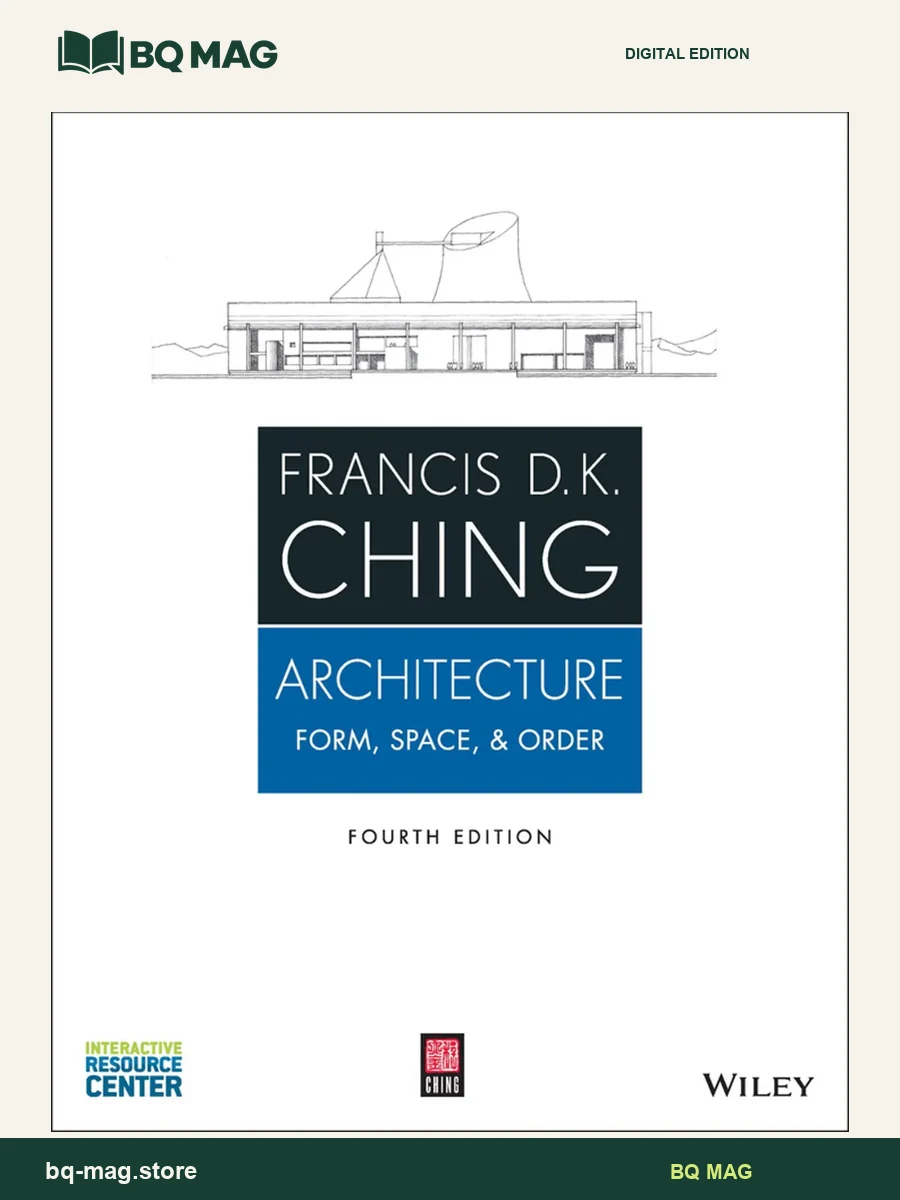
Architecture: Form, Space, and Order, 4th Edition, by Francis D. K. Ching, introduces a visual vocabulary for architectural design. The book examines how elementary forms and spaces can be organized and experienced, using drawings, diagrams, and examples to make abstract relationships easier to study. Its illustrated format supports students who are learning to describe the components of a design, to read a plan or spatial sequence, and to connect formal choices with their effects on an environment.
What architectural ideas does the book explore?
The chapter sequence develops from primary elements to form, form and space, organization, circulation, proportion and scale, and design principles. The early material considers point, line, plane, volume, and the way form is shaped, articulated, or related to surrounding space. Organization chapters discuss spatial arrangements and patterns. Sections on circulation look at how people approach, enter, and move through buildings, including the configuration of paths and the relationship between path and space. Later chapters compare proportional systems and principles that can guide design thinking.
How does its visual approach help?
Ching pairs concise explanations with architectural illustrations so readers can compare relationships across examples instead of relying only on verbal definitions. Form and space are discussed in relation to openings, enclosure, light, view, circulation, and scale. This makes the book useful when students need a reference for studio vocabulary or a way to review how a design organizes its parts. It encourages observation and critical thought; it does not present a single style or formula that every building should follow.
Who may use this architecture reference?
Students in architecture, interior design, and related spatial-design courses can use it while learning fundamentals or preparing for studio assignments. Instructors may refer to it when introducing design language, and practicing designers may keep it nearby for a visual reminder of basic concepts. Because the fourth edition is an older title, match it to the exact edition and reading list required by a course.
Check the edition and PDF format
This listing identifies the fourth edition in PDF format. Confirm the edition and ensure your device displays the diagrams and page layouts clearly. Open the four-image preview to inspect sample pages, then browse engineering and architecture ebooks or the full catalog.
ISBN and edition details
ISBN for this edition (reference): 9781118745083
This identifier belongs to a published version of the matching title/edition. A format-specific ISBN for the supplied PDF has not been independently confirmed.
Willem Kottwitz –
Für jeden Studenten aber auch Architekten ein hervorragendes Buch!
Danielle –
I LOVE THIS Ebook!!! Even if you are not into architecture and only into design or your an artist, this is a great ebook to have. It’s got some amazing illustrations that are so beautiful to look at. I purchased not only the digital copy of this ebook but also the ebook copy of this. In an aritst perspective this is great to look at to see the basic structures of a building. The illustrations are in sketch form and often describe each structure as well as location this is an awesome ebook to have.
Tim –
Architecture: Form, Space, and Order is an ebook that provides a comprehensive overview of the fundamental principles of architecture. Francis uses simple language to explain complex concepts, making the ebook very easy for readers in different levels of knowledge. It’s very well written and has a lot of good illustrations for those who like visual explanation. Anyone interested in the field should pick this ebook up. It is an excellent starting point for anyone interested in architecture.
Dan –
Architecture: Form, Space, and Order” is a masterpiece that seamlessly weaves together the fundamental principles of architectural design. Francis D.K. Ching’s clarity of thought and illustrative prowess make complex concepts remarkably accessible. The ebook’s structured approach to form and space provides a solid foundation for understanding architectural design, making it an indispensable resource for students and professionals alike. With its timeless insights, this ebook stands as an enduring guide for anyone passionate about the art and science of architecture.
haysam zaydan –
Perfect on time and on quality
Riyaseen M. –
Very helpful for my studies. Then clearly understand the sketches image. Nice
Martin Stephenson –
Clear defined line work illustrations, all in black and white, no colour to confuse, complete explanation and examples, a monster size ebook with content deserving of every page. Buy this ebook!!
Doug Wittnebel –
I use this ebook as part of my educational process for students at University. Ching is a master at what he does with any and all architectural history and themes. And did I mention the drawings? Super, clear and informative. Highly recommended!
Thanh T. –
Very helpful