
What you’ll find inside
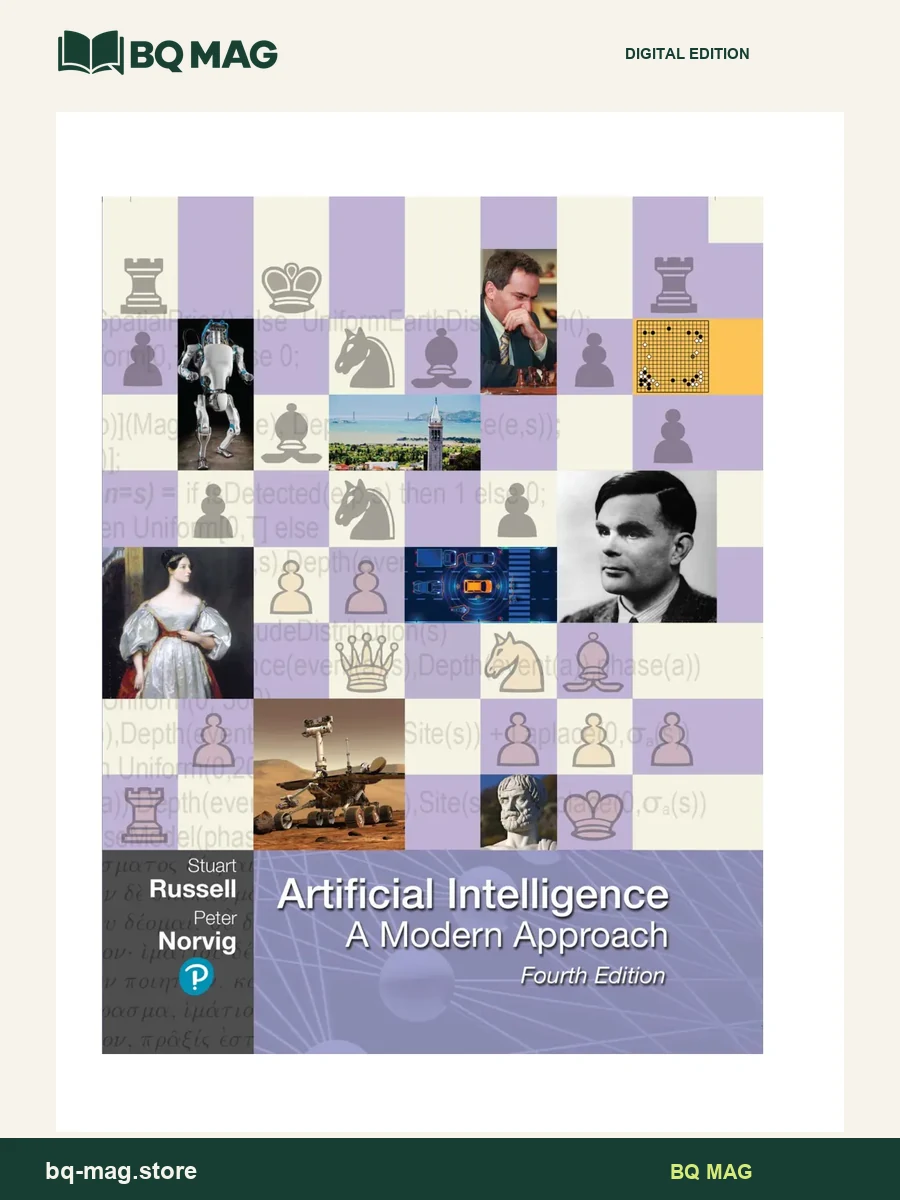
Artificial Intelligence: A Modern Approach, 4th Edition by Stuart J. Russell and Peter Norvig introduces the theory and practice of artificial intelligence through a broad, connected view of the field. This U.S. edition builds from foundational ideas toward methods used to represent problems, reason about uncertain information, learn from data, and build agents that act in changing environments. The book is organized as a substantial course text, with chapter summaries and bibliographical notes that support further study.
What topics does the fourth edition cover?
The opening chapters establish what AI studies and how intelligent agents interact with their environments. The problem-solving section moves through search, complex environments, adversarial games, and constraint satisfaction. Later chapters develop logical agents, first-order logic, inference, knowledge representation, and automated planning. These foundations lead into uncertainty, probabilistic reasoning over time, probabilistic programming, and decisions involving individuals and multiple agents.
The learning section covers learning from examples and probabilistic models, deep learning, and reinforcement learning. The final chapters turn to natural language processing, deep learning for language, robotics, philosophy and ethics of AI, and possible future directions. Together, the sequence is designed to show how the parts of AI connect, while giving instructors room to focus on selected methods or applications.
Who is this AI textbook for?
Students in an artificial-intelligence course can use the chapter progression alongside lectures, programming exercises, and a current syllabus. Instructors may consult it when planning a course that spans classical search and logic as well as modern machine learning. Readers comparing editions should confirm that the U.S. fourth edition is the version named by their course; a separately titled Global Edition is listed elsewhere in the catalog and may have different publication details.
Check the edition and sample pages
This product record identifies the fourth edition by Russell and Norvig in PDF format. Review the title, author names, and edition against your reading list, and check that your reading app displays code, mathematical notation, figures, and tables as expected. Use the four-image preview to inspect sample pages before choosing. Browse computer science and IT ebooks or return to the ebook catalog.
ISBN and edition details
ISBN for this edition (reference): 9780134610993
This identifier belongs to a published version of the matching title/edition. A format-specific ISBN for the supplied PDF has not been independently confirmed.


J. Andrews –
LOTS of extensive info. Great for a reference. Computer education required.
Raj –
Ideal for reference
Jonathan Barth –
The ebook is more dense than I thought I would be. I have already done several courses in Machine Learning and Data Science. I would say this ebook is not for beginners.
Don –
A large text with 1200+ pages, it is a comprehensive introduction to the various components that go into AI. I particularly liked the first chapters that reviewed the history of AI, going back decades, that put the subject matter into historical context. Way too much for a casual read, it is a great reference.
Shadrack Nyamekye –
Meaningful!
R Trahan –
Should have clearly indicated this was an Indian market edition. I figured out how to get the missing chapter and it appears the content is the same. However, the seller should disclose in the description the variance in what they are selling.
Thomas –
👍👍👍
chaz –
comence leyendo la 2da edicion para conocer sobre el tema y supero mis expectativas, por eso creo que esta 4ta edicion es superior
MPC –
Not really useful for learning the topic .
svg menon –
Great ebook. Give all details of AI.