
What you’ll find inside
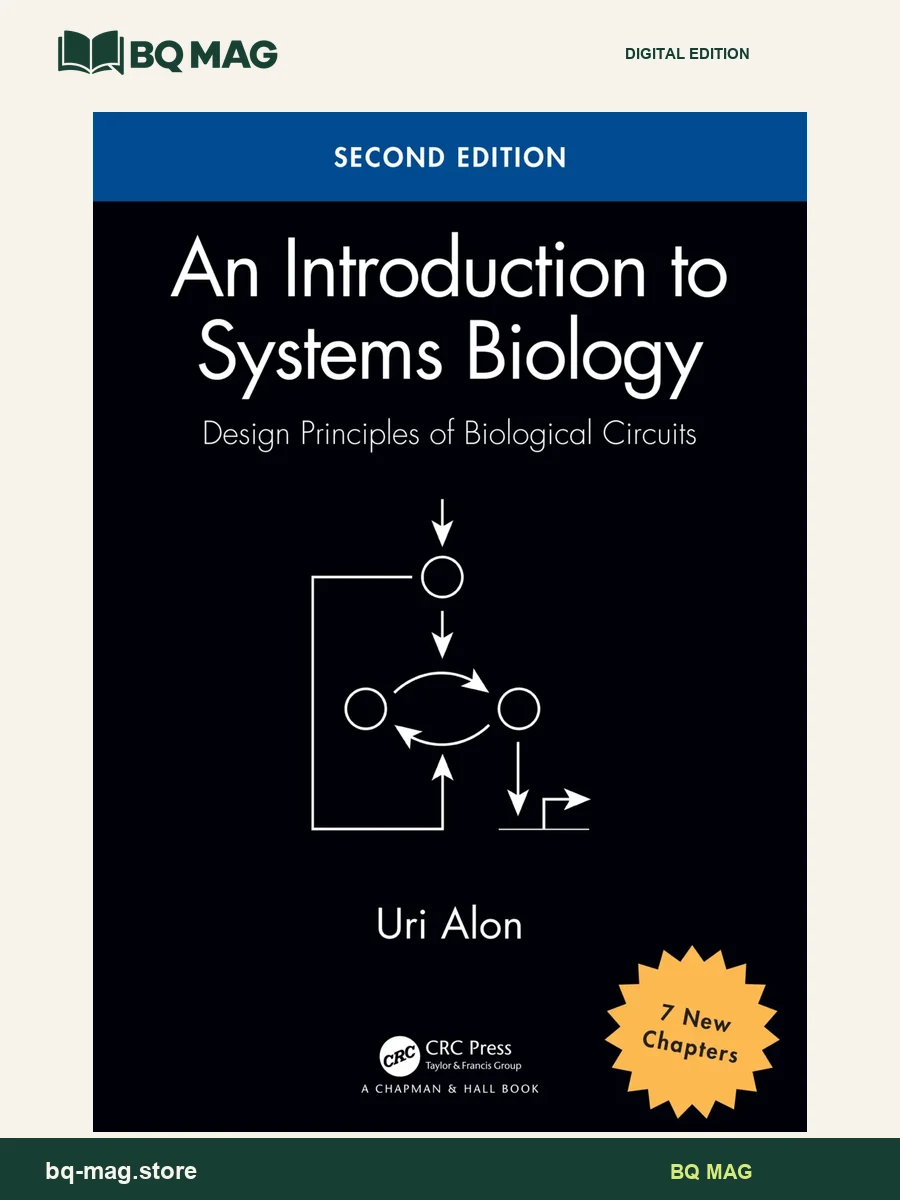
An Introduction to Systems Biology: Design Principles of Biological Circuits, Second Edition, by Uri Alon, examines how recurring circuit patterns help explain the behavior of biological systems. Written for students and researchers, it uses network models to connect gene regulation and cell behavior with principles such as feedback, robustness, adaptation and optimal design.
Read biological networks as circuits
The opening part introduces transcription networks and motifs such as autoregulation and feedforward loops. It shows how circuit structure can affect response time, filtering, pulses and temporal gene-expression programs. Later chapters consider oscillations, feedback and memory, then examine mechanisms that make signaling more reliable, including proofreading, bacterial chemotaxis and fold-change detection. These examples give readers ways to compare how different systems process changing inputs.
From robustness to design trade-offs
The book continues through dynamical compensation in tissues, spatial patterning during development, optimal gene-circuit design and modularity. Its final sections ask how cells balance competing demands and how recurring structures can emerge across levels of biological organization. Exercises, further-reading sections and appendices on gene input functions, graph properties and noise in gene expression extend the core models.
For quantitative biology study
This second edition can support systems biology, computational biology and quantitative life-science courses that use mathematical reasoning to study biological networks. It is especially relevant when a course moves between molecular mechanisms and whole-system behavior. The publisher lists a 342-page bibliographic length. Check the title, edition and PDF format against your syllabus; the ebook preview provides four sample images for a quick file check.
Working through the material
Readers can move from small circuit motifs toward the behavior of larger networks, then compare how feedback, noise and changing environments affect system performance. The final chapters and appendices extend that route into optimality, modularity and quantitative models. Basic mathematics is useful, and each chapter’s exercises offer a way to test understanding alongside the explanations.
Browse more biology and life-science ebooks or return to the ebook catalog.
ISBN and edition details
ISBN for this edition (reference): 9780429283321
This identifier belongs to a published version of the matching title/edition. A format-specific ISBN for the supplied PDF has not been independently confirmed.




Reviews
There are no reviews yet.